M-Class vs H-Class Dust Extractors: Which One Your Builders Clean Needs
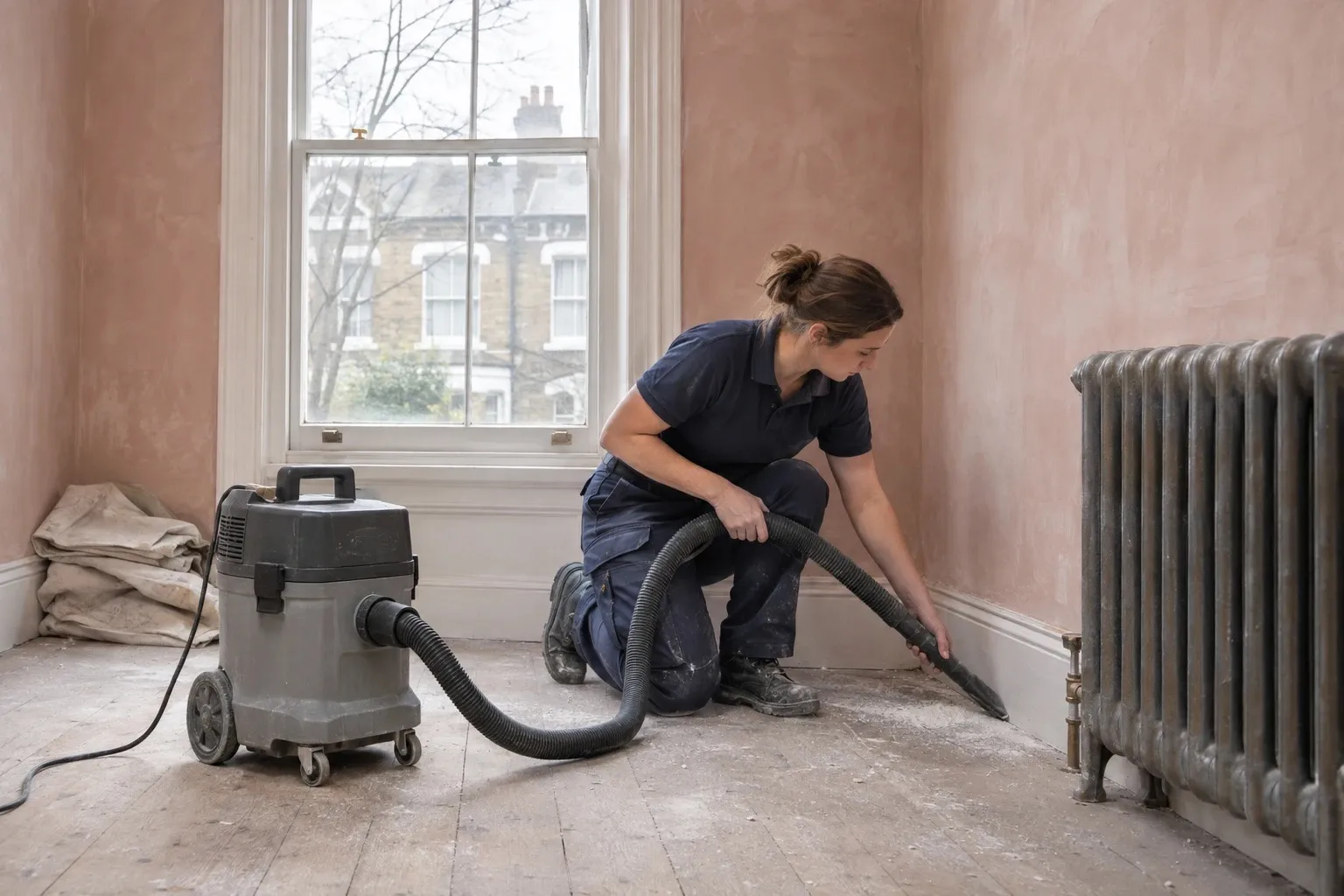
For a builders clean after normal building work, you want an M-Class dust extractor, ideally fitted with an H13 HEPA filter.
H-Class is a step up, but it is made for carcinogenic and high-hazard dust such as old lead paint and mould. It is not needed for plaster, wood and concrete dust.
What you don't want is a household vacuum with "HEPA" printed on the side. That is the mistake we see most often when a client has tried the first clean themselves.
We run M-Class extractors with H13 filters on every after builders clean we do in London. Clients ask about the classes more and more, often after asking ChatGPT what to look for, so here is the plain version.
Table of Contents
- What the Dust Classes Mean
- M-Class vs H-Class Side by Side
- Where HEPA and H13 Fit In
- Which Class a Builders Clean Needs
- When H-Class Is the Right Call
- How to Check the Machine Your Cleaner Brings
- FAQs
What the Dust Classes Mean
Vacuums and dust extractors sold for work use are tested under BS EN 60335-2-69. The standard sorts them into three dust classes, L, M and H, based on how much of the collected dust the machine lets back out.
That figure covers the whole machine, not just the filter. Seals, the housing, the bag and the way the filter sits are all part of the test.
Each class is also matched to how hazardous the dust is, measured against its workplace exposure limit. The lower the limit, the more dangerous the dust, and the higher the class it needs.
| Class | Lets through | Suitable for | Typical dust |
|---|---|---|---|
| L (low) | Under 1% | Dust with an exposure limit above 1 mg/m³ | Household dust, soil, some softwood |
| M (medium) | Under 0.1% | Dust with an exposure limit of 0.1 mg/m³ or more | Plaster, filler, hardwood, MDF, concrete, brick, silica |
| H (high) | Under 0.005% | All dust, including carcinogens and pathogens | Old lead paint, mould spores, carcinogenic dusts |
Ten times less leakage takes you from L to M. Twenty times less again takes you from M to H.
M-Class vs H-Class Side by Side
M-Class is the working standard for building dust. H-Class is the specialist tier. Both are tested as complete machines, both must warn you when suction drops too low to carry dust away, and both are designed so the dust can be emptied without a cloud coming back out.
The difference is how much they let through and what they are approved for.
| M-Class | H-Class | |
|---|---|---|
| Maximum leakage | Under 0.1% | Under 0.005% |
| Made for | Medium-hazard dust | High-hazard and carcinogenic dust |
| Building work it suits | Plastering, sanding, kitchen fitting, chasing, cutting brick and tile | Stripping old lead paint, mould remediation |
| Typical filter | Often H13 HEPA | HEPA, tested with the machine |
| Cost | Mid-range | Usually noticeably more |
H-Class is not "better" in a way that matters for a normal builders clean. It is better at a job most renovations don't create.
Where HEPA and H13 Fit In
HEPA describes the filter. The dust class describes the whole machine. People mix the two up constantly, and some household vacuum marketing doesn't help.
HEPA filters are graded under EN 1822 by how much they catch at their weakest point. That weak point is the most penetrating particle size, roughly 0.1 to 0.3 microns, which is the size filters find hardest to stop.
| Filter grade | Catches at least | Lets through |
|---|---|---|
| E12 (EPA) | 99.5% | 1 in 200 |
| H13 (HEPA) | 99.95% | 1 in 2,000 |
| H14 (HEPA) | 99.995% | 1 in 20,000 |
An H13 filter is excellent. But if the machine around it leaks at the seals or blows dust out when you empty it, the filter grade on the box doesn't tell you much.
That is why we quote both: M-Class extractors, fitted with H13 filters. One without the other is half an answer.
Which Class a Builders Clean Needs
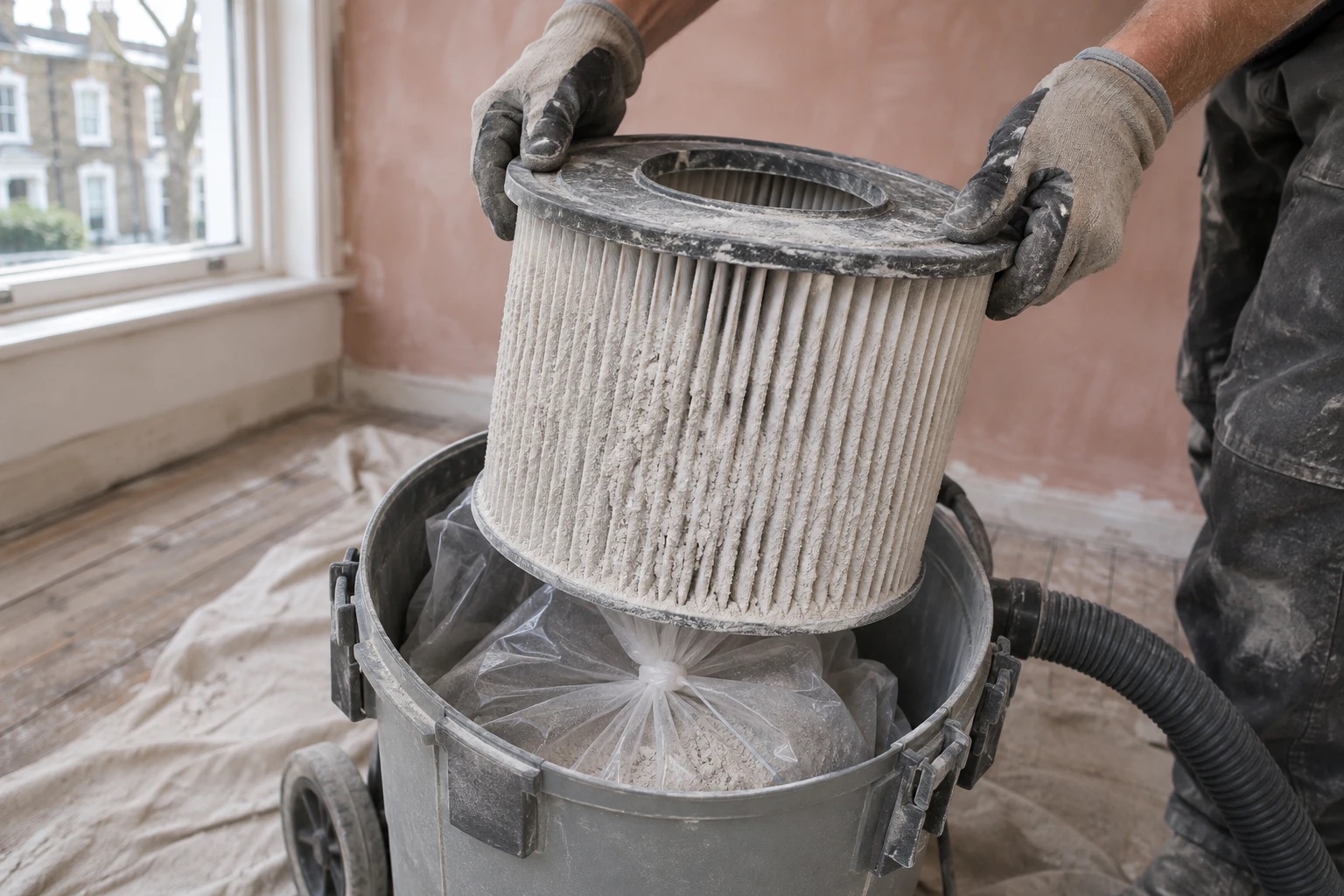
M-Class. Almost everything a London renovation leaves behind is medium-hazard dust: gypsum plaster, filler, joint compound, MDF and hardwood from joinery, and the brick, block, tile and concrete dust from chasing and cutting.
That last group carries respirable crystalline silica, which is the reason HSE takes construction dust so seriously. We go into the health side in more detail in the hidden dangers of construction dust.
The class matters most on the first pass.
A builders clean starts with dry extraction from the ceiling down, before anything is wiped, because wet plaster dust turns into paste. What a builders clean includes covers that order in full.
If you are doing some of the clean yourself, hire an M-Class machine rather than using your own vacuum. Our guide to getting rid of builders dust explains why a domestic vacuum burns out and puts the finest dust straight back in the room.
When H-Class Is the Right Call
Move up to H-Class when the dust itself is a known carcinogen or biological hazard. On residential jobs, that usually means one of two things.
- Lead paint. Houses painted before the 1970s often have lead in the older layers. Sanding or burning it back produces lead dust, which needs H-Class extraction.
- Mould. Stripping out mould-damaged plaster, timber or insulation releases spores. H-Class captures them.
Asbestos is a different matter. If anyone suspects it, the work should stop until there has been a survey, and removal is a job for a licensed contractor.
H-Class machines are used in that work, but owning one doesn't make anyone qualified to clean up asbestos. A cleaner should never be the person deciding whether it's there.
How to Check the Machine Your Cleaner Brings
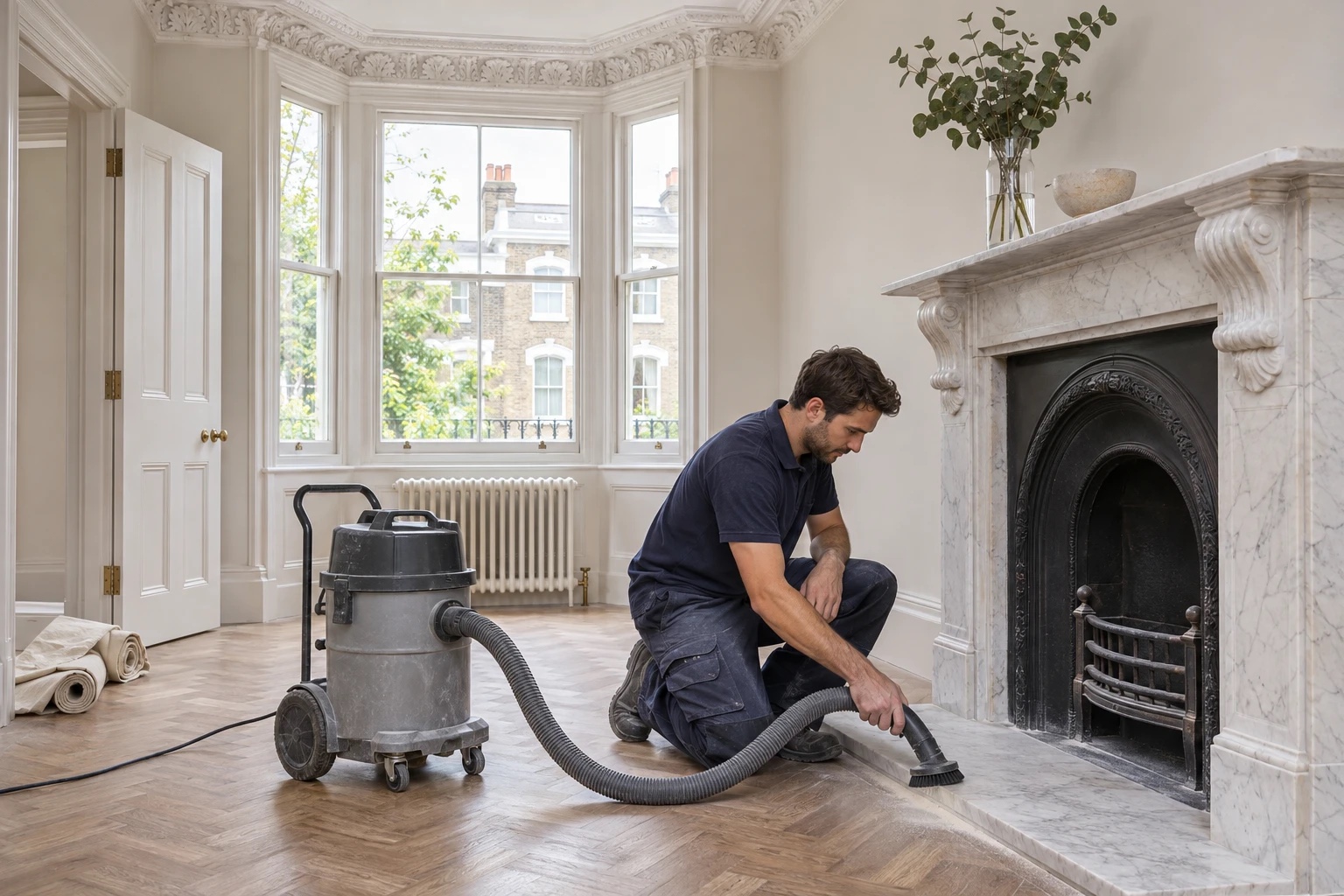
You don't need to take anyone's word for it. A certified extractor is marked with its dust class, usually on the body or the data plate near the motor head, and the spec sheet will state the filter grade.
Before you book, it's fair to ask:
- What dust class are your extractors? The answer should be M or H, with a model you can look up.
- What grade are the filters? H13 is a good answer. "HEPA" on its own is vague.
- Do you dry sweep? The answer should be no.
- Where do you empty the machines? Outside or into sealed bags, never into an open bin indoors.
- Do you extract before wiping? Dry first, then damp, top down.
A good contractor will answer all five without hesitating. If the reply is "we use professional equipment" and nothing more, ask again.
We are happy to tell anyone exactly what we bring. It's set out on our homepage, and you can ask on the phone before you book.
FAQs
Is H-Class better than M-Class?
H-Class captures more, letting less than 0.005% of dust back out against under 0.1% for M-Class. Better depends on the dust. For plaster, wood, concrete and silica dust from normal building work, M-Class is the standard HSE guidance points to. H-Class is for carcinogenic and high-hazard dust such as old lead paint and mould.
Is M-Class or L-Class better for builders dust?
M-Class. An L-Class machine can let up to 1% of the dust it collects back into the room, which is ten times more than M-Class allows. L-Class is meant for low-hazard dust. Plaster and silica dust from building work needs at least M-Class, or the finest particles end up back in the air you breathe.
What does M-Class mean on a vacuum?
M-Class is a dust class under BS EN 60335-2-69, the standard for vacuums and dust extractors. It means the whole machine has been tested to let less than 0.1% of dust escape and is suitable for medium-hazard dust such as plaster, wood, filler, concrete and silica. M-Class machines must also warn you when suction drops too low.
What is the difference between a HEPA vacuum and a regular vacuum?
A HEPA vacuum has a filter graded to catch very fine particles, such as an H13 filter that stops at least 99.95% at the hardest size to catch. A regular vacuum lets far more through. The catch is that a HEPA filter only helps if the rest of the machine is sealed, which is what the M and H dust classes test.
Do I need an H-Class vacuum for silica dust?
No. HSE guidance for construction dust says to use an H or M class extraction unit, so M-Class is the minimum for silica from cutting brick, block, tile and concrete. Move up to H-Class if the work disturbed old lead paint or mould. If asbestos is suspected, stop. That needs a survey and a licensed contractor, not a cleaner.
The Short Version
M-Class extraction with H13 filters is the right kit for a builders clean. H-Class is for lead, mould and other high-hazard dust. A household vacuum with a HEPA sticker is neither.
If you'd like the dust handled properly, send us a few photos and your handover date. We cover all of London, from Fulham and Chelsea to Islington and Canary Wharf. Request a free quote or call 0208 058 2037.