Post Construction Cleaning: The Complete Guide for London Projects
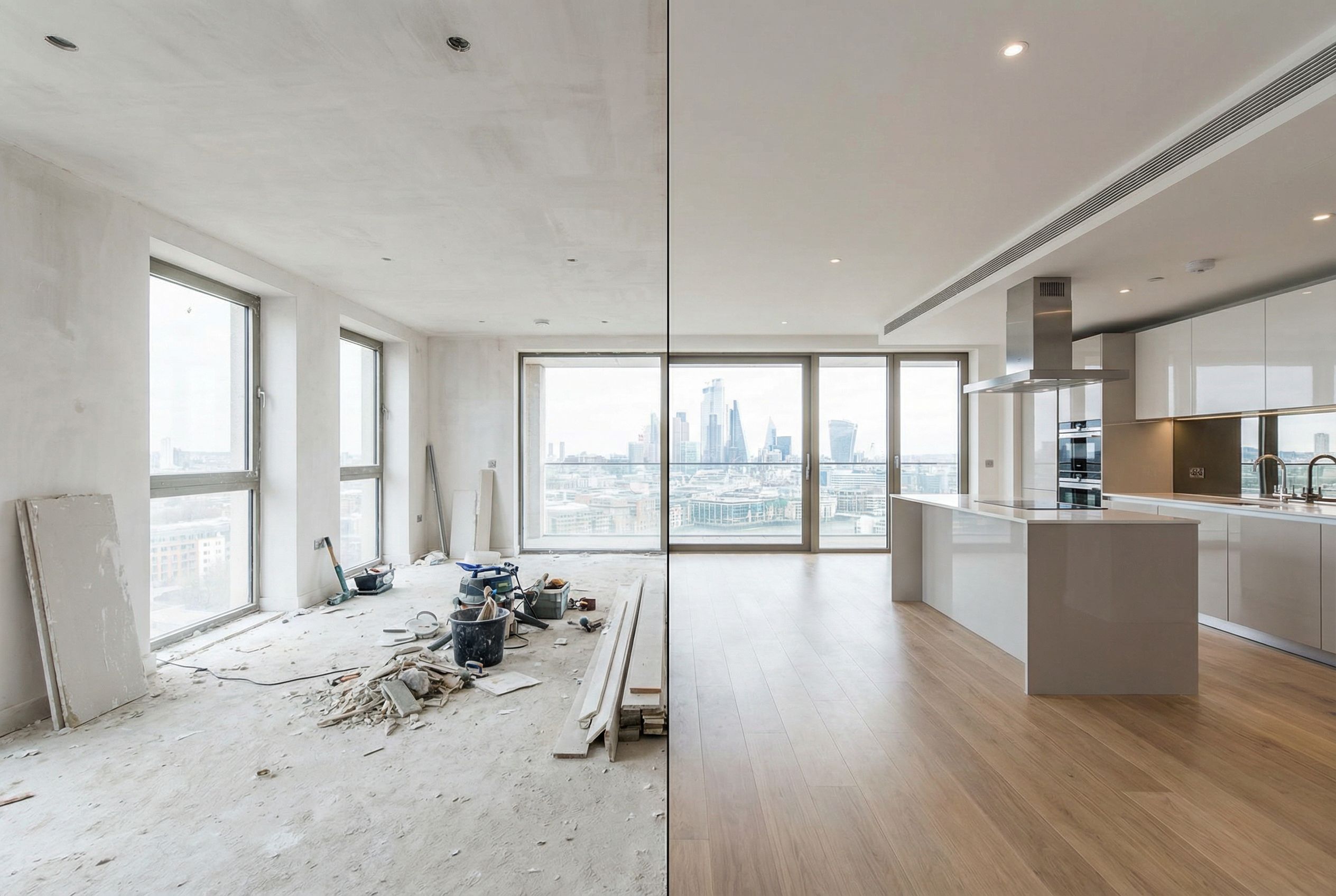
Every construction project ends with the same problem: the building work is finished, but the property isn't ready for anyone to use. There's dust on every surface, plaster residue in the window tracks, protective film on the appliances, and a fine grey coating on floors that look like they've never been cleaned.
That gap between "construction complete" and "ready to occupy" is what post construction cleaning fills. It's the final phase of any build or renovation, and in London, it's often the most time-sensitive part of the entire programme.
We've handled post construction cleaning on everything from single-flat refurbishments in Chelsea to 100-unit new build handovers in Peterborough. The process is broadly the same regardless of scale, but the details vary enormously depending on the type of project, the finishes involved, and the timeline you're working to.
Here's what you need to know.
Table of Contents
- What Is Post Construction Cleaning?
- The Three Stages of Post Construction Cleaning
- What's Included at Each Stage
- How Long Does Post Construction Cleaning Take?
- Post Construction Cleaning for Different Project Types
- London-Specific Challenges
- Health and Safety Requirements
- When to Schedule Your Clean
- Post Construction Cleaning Checklist
- How Much Does It Cost?
- FAQs
What Is Post Construction Cleaning?
Post construction cleaning is the professional deep clean carried out after building, renovation, or refurbishment work to remove construction debris, dust, and residue. It transforms a finished construction site into a clean, safe, and presentable space that's ready for handover, snagging, or occupation.
It's not a single event. On most projects, post construction cleaning happens in stages, each with a different purpose and level of detail. Skip a stage, or do them in the wrong order, and you'll end up paying to clean the same property twice.
The terminology in the industry is inconsistent. You'll hear "post construction cleaning," "after builders cleaning," "post builder cleaning," and "construction clean" used interchangeably. They all refer to the same process, though some companies use specific terms to describe different stages of that process.
The Three Stages of Post Construction Cleaning
Most construction projects need a phased approach to cleaning. Trying to achieve a perfect finish in a single pass doesn't work, because construction dust behaves differently to normal household dirt.
Fine plaster and concrete dust stays airborne for 24-48 hours after disturbance. Clean a room today, and tomorrow there's a fresh layer on every surface. This is physics, not bad cleaning.
Stage 1: The Rough Clean
This happens while the site is still active or immediately after the main trades have left. The goal is to remove bulk debris so the property is safe to walk through.
What it covers:
- Clearing rubble, packaging, and offcuts
- Removing protective coverings from floors and surfaces
- Basic vacuuming to remove heavy dust buildup
- Making the site safe for snagging inspections
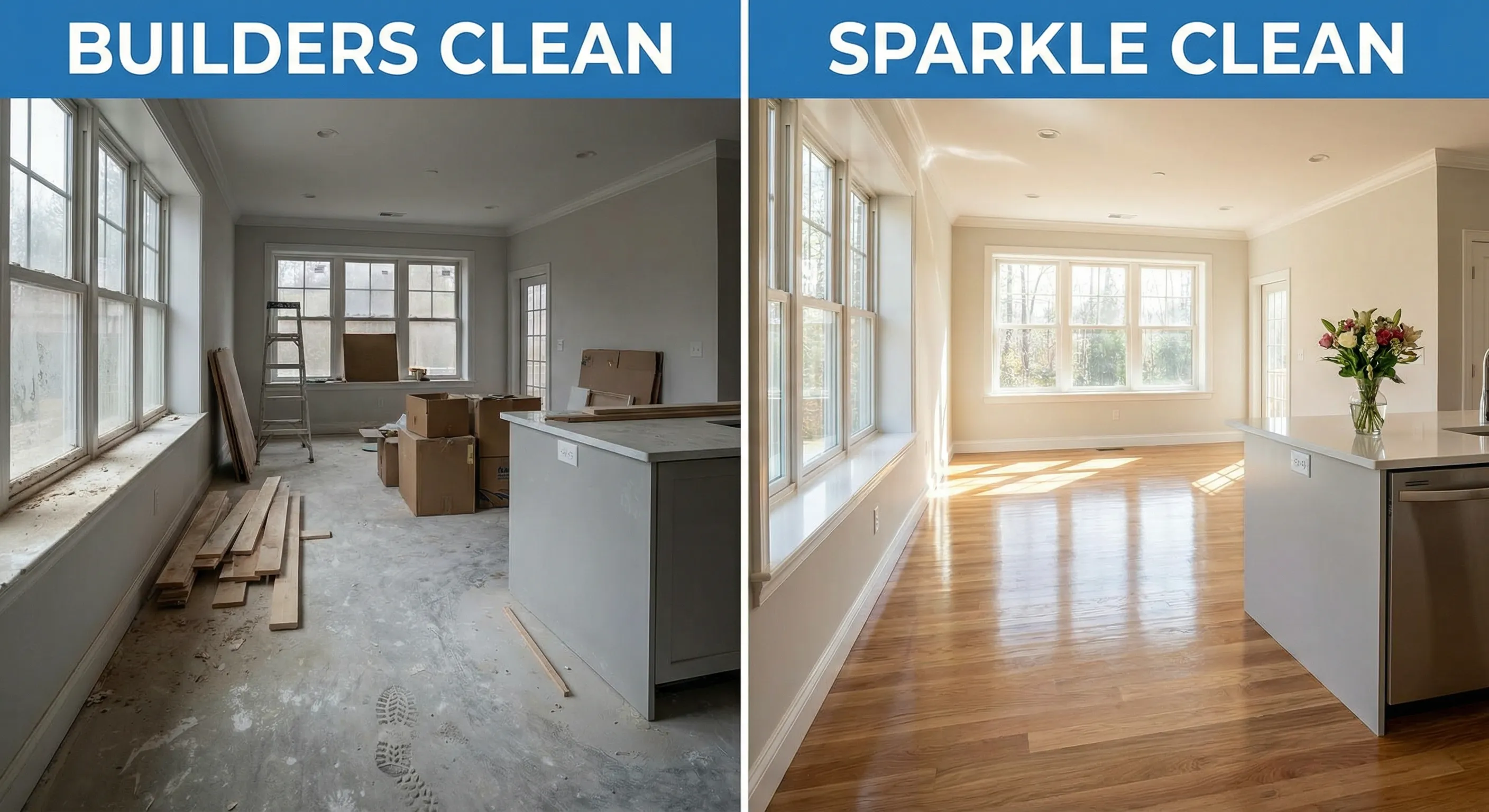
Stage 2: The Builders Clean
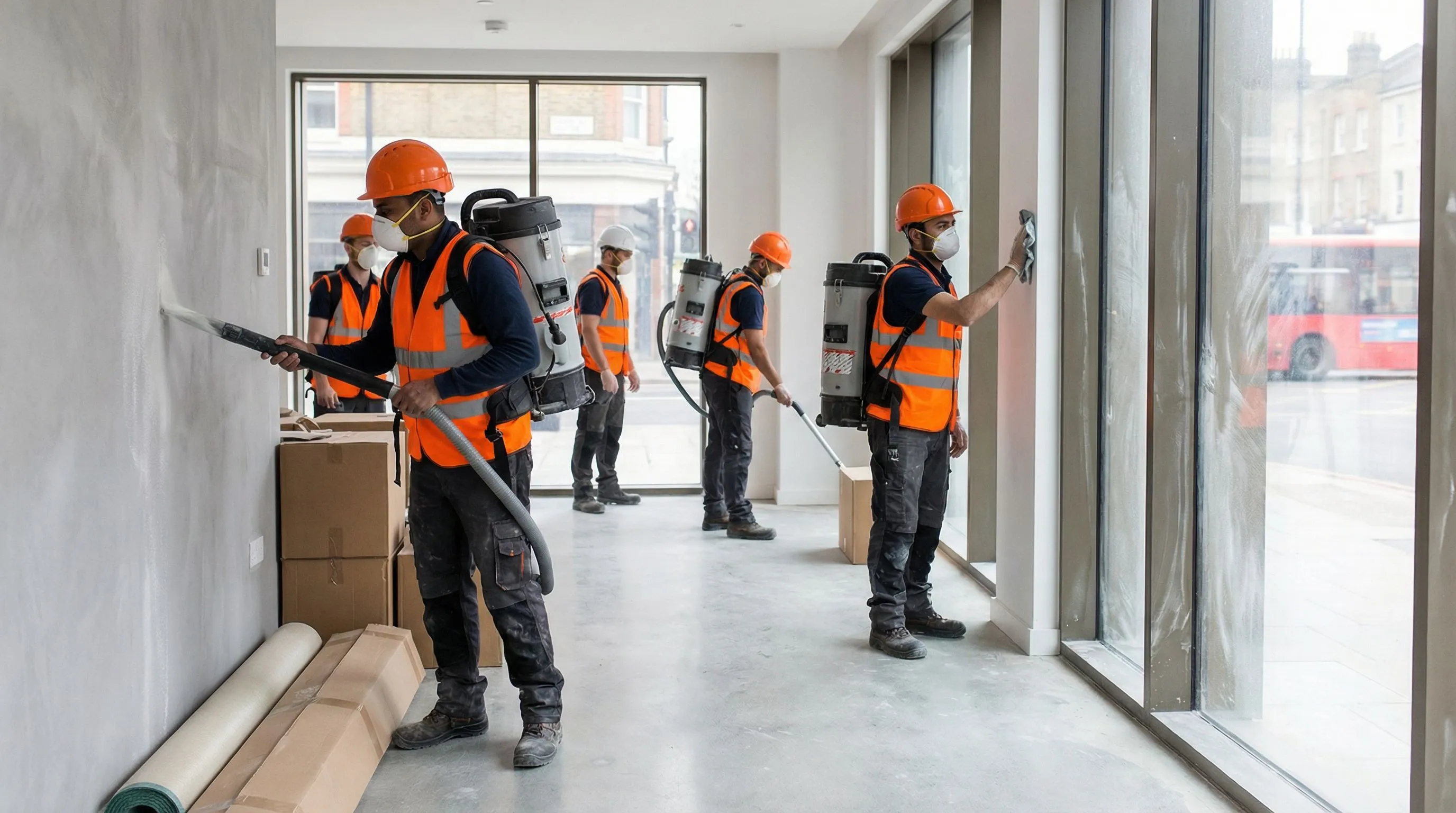
This is the heavy-duty clean. It removes the ingrained construction mess that a rough clean doesn't touch. We use industrial HEPA vacuums, specialist scrapers, and professional-grade cleaning products at this stage.
What it covers:
- Extraction of fine dust from all surfaces, corners, and fittings
- Paint and plaster removal from windows, floors, and fixtures
- Adhesive and label removal from new appliances and sanitaryware
- Grout haze removal from tiles
- Detailed cleaning of kitchens and bathrooms
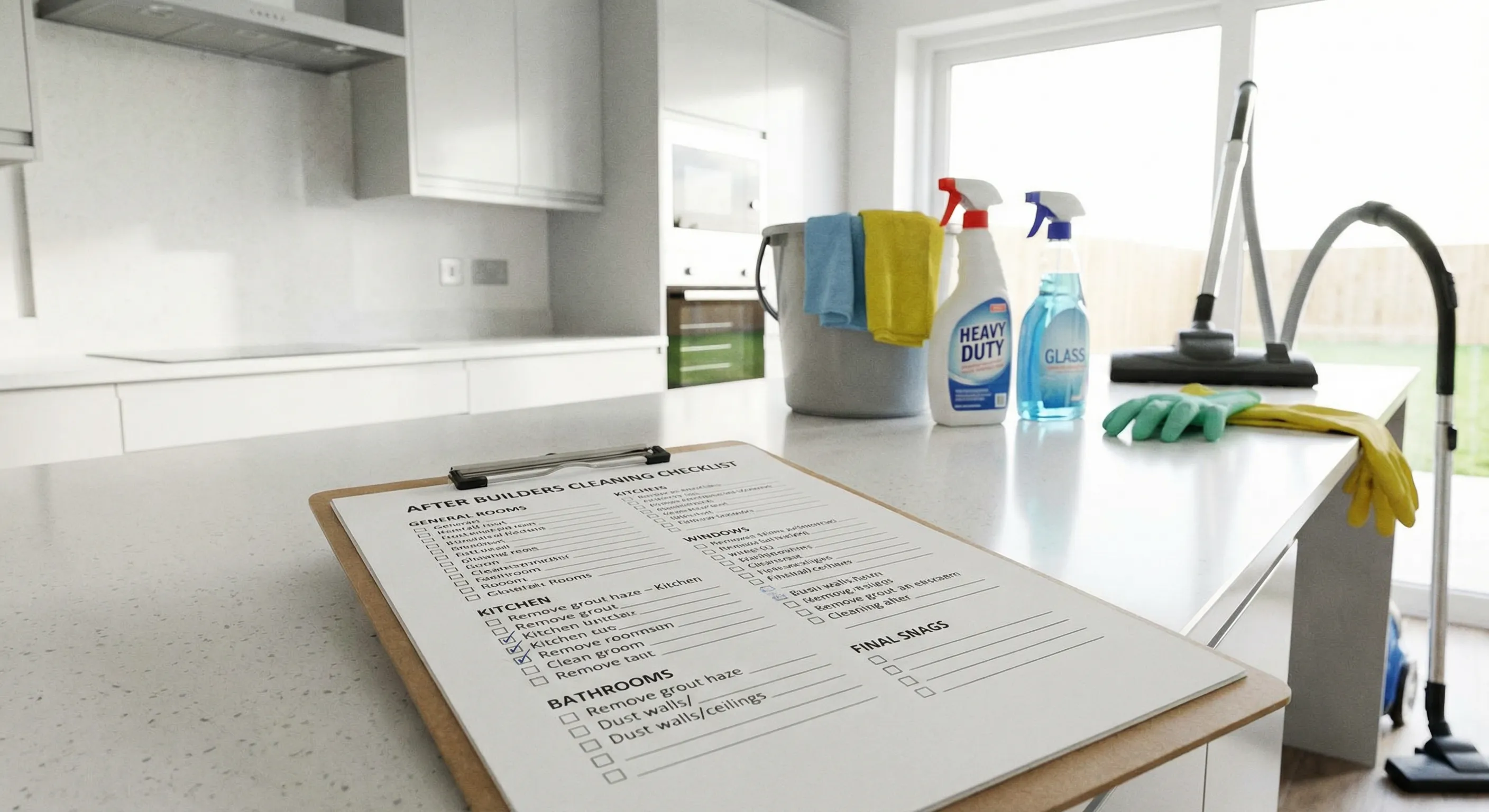
For a full breakdown of what's included, see our after builders cleaning checklist.
Stage 3: The Sparkle Clean
The final polish. This happens after snagging repairs are complete and the dust has settled (literally). The result is a property that looks and feels brand new.
What it covers:
- Inside every cupboard, drawer, and appliance
- All glass polished to streak-free finish
- Chrome and stainless steel buffed
- Floors polished or machine-cleaned
- The "white glove" standard for handover or photography
We explain the difference between these stages in much more detail in our guide to builders clean vs sparkle clean.
What's Included at Each Stage
Here's a direct comparison of what each stage covers:
| Area | Rough Clean | Builders Clean | Sparkle Clean |
|---|---|---|---|
| Debris removal | All rubble and packaging cleared | Remaining small debris | N/A |
| Dust extraction | Surface-level vacuuming | Full HEPA extraction from all surfaces | Final micro-dust removal |
| Windows | N/A | Stickers, paint, and plaster removed | Glass polished streak-free |
| Floors | Basic sweep | Vacuum, mop, grout haze removed | Buffed or machine-polished |
| Kitchens | N/A | Units inside and out, appliances cleaned | Sanitised, polished, film removed |
| Bathrooms | N/A | Sanitaryware cleaned, tiles scrubbed | Chrome polished, grout sealed |
| Light fittings | N/A | Dusted and wiped | Detailed and polished |
| Inside cupboards | N/A | Vacuumed out | Wiped and sanitised |
How Long Does Post Construction Cleaning Take?
This depends on property size, the type of construction work, and the level of clean required. But here's what we typically see:
| Property Type | Builders Clean | Sparkle Clean | Total |
|---|---|---|---|
| 1-2 bed flat (renovation) | 4-6 hours | 3-4 hours | 7-10 hours |
| 3-4 bed house (full refurb) | 1-2 days | 0.5-1 day | 1.5-3 days |
| 5+ bed house (major works) | 2-3 days | 1-2 days | 3-5 days |
| New build apartment (per unit) | 4-8 hours | 3-5 hours | 7-13 hours |
| Multi-unit development (100 units) | 4-8 weeks | 2-4 weeks | 6-12 weeks |
These are working-hour estimates, not calendar time. Factor in the 24-48 hour settling period between the builders clean and sparkle clean when planning your programme.
Post Construction Cleaning for Different Project Types
Residential Renovations
The most common type. A homeowner has had a kitchen, bathroom, or full-house renovation and the builders have left.
Key considerations:
- Protecting existing furnishings that stayed in the property during works
- Dust migration into rooms that weren't part of the renovation
- Delicate finishes like limestone, marble, and bespoke joinery that need specialist products
New Build Developments
Multi-unit residential developments have a completely different dynamic. You're cleaning 10, 50, or 100 identical units, often to a specification agreed with the developer.
Key considerations:
- Phased cleaning to match the construction programme
- Consistent standard across every unit (plot-by-plot snagging)
- Tight handover deadlines tied to completion dates
- Coordination with other trades still working on site
Commercial and Mixed-Use Projects
Offices, retail spaces, and mixed-use developments involve larger floor areas, different materials, and often stricter compliance requirements.
Key considerations:
- Building management access and working-hour restrictions
- Specialist floor types (polished concrete, raised access, carpet tiles)
- Ventilation and HVAC cleaning to remove dust from ductwork
- Fire safety — cleared access routes and properly cleaned fire doors
London-Specific Challenges
Post construction cleaning in London comes with complications you won't find elsewhere:
Access and parking. Many London properties have no off-street parking. Congestion charges, permit parking, and narrow streets mean equipment delivery needs planning. We've carried industrial vacuum units up five flights of stairs in mansion blocks with no lift. It's doable, but it adds time.
Building management restrictions. Most managed buildings in London restrict working hours, noise levels, and use of communal areas. We regularly work around 8am-5pm weekday-only restrictions, which affects scheduling on time-critical projects.
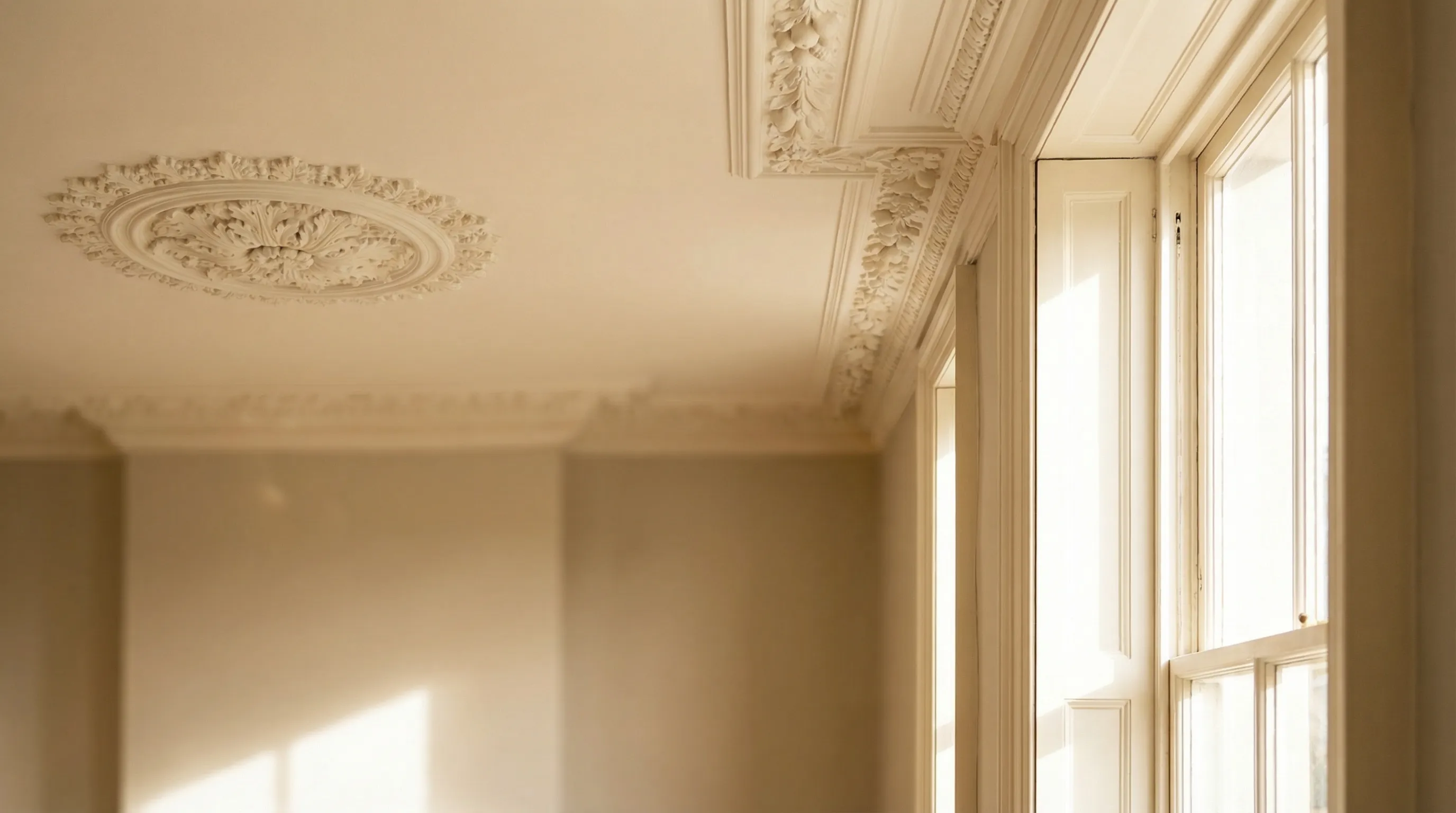
Period property details. London has a disproportionate number of listed buildings, Victorian terraces, and Georgian townhouses. Intricate cornicing, original sash windows, and heritage fittings take significantly longer to clean than modern straight-edged finishes.
High-specification finishes. London renovation projects tend to use premium materials. Marble, engineered stone, brass fixtures, bespoke cabinetry — each needs specific cleaning products and techniques to avoid damage. Using the wrong product on a honed marble surface, for example, can etch it permanently.
We work across all London boroughs, from Kensington and Hampstead in the west and north to Canary Wharf and Bromley in the east and south.
Health and Safety Requirements
Post construction cleaning isn't just about aesthetics. Construction dust is a genuine health hazard.
Fine silica dust from concrete, mortar, and stone cutting is classified as a carcinogen. The HSE estimates it contributes to over 500 construction worker deaths per year. While a single renovation creates lower exposure than a career on building sites, it's still a risk that needs managing properly.
We've written a full article on the hidden dangers of construction dust if you want the detail, but here's what matters for post construction cleaning:
Equipment requirements:
- Industrial HEPA vacuums (not domestic) — these trap 99.97% of particles including respirable silica
- FFP3 masks for cleaning operatives
- Damp wiping rather than dry sweeping (sweeping launches dust into the air)
Compliance:
- Our teams hold CSCS cards (Construction Skills Certification Scheme)
- Full public liability insurance covering construction environments
- Risk assessments and method statements (RAMS) for every project
- CDM Regulations awareness for sites where they apply
When to Schedule Your Clean
Getting the timing right saves money and avoids re-cleaning. Here's the sequence that works:
- Main construction work completes
- Rough clean (same day or next day)
- Remaining trades finish (electricians, decorators, etc.)
- Builders clean (allow a full day minimum depending on property size)
- Snagging inspection (now you can actually see the surfaces to inspect them)
- Builder returns to fix snags
- 24-48 hour settling period (dust settles from the snag repairs)
- Sparkle clean (the final polish)
- Handover / move in
The critical mistake is booking steps 5 and 8 too close together. If you sparkle clean and then the builder comes back to fix a cracked tile and repaint a patch, you need another clean. Build the settling period into your programme.
For larger developments, book your post construction cleaning contractor early. On projects with 20+ units, we typically need 3-4 weeks' notice to crew up properly. Last-minute bookings are possible but may affect scheduling flexibility.
Post Construction Cleaning Checklist
A quick-reference checklist for what should be covered in a comprehensive post construction clean:
Every Room
- Construction dust extracted from all surfaces (HEPA vacuum)
- Walls wiped down
- Skirting boards, architraves, and door frames cleaned
- Doors cleaned both sides, handles polished
- Light switches and sockets wiped
- Light fittings dusted and cleaned
- Radiators cleaned (including behind and between panels)
- Window sills cleaned
- Internal windows cleaned, paint/plaster removed
- Hard floors vacuumed and mopped
- Carpets vacuumed (industrial grade)
Kitchens
- Units cleaned inside and out
- Worktops sanitised
- Appliances cleaned (oven, hob, extractor, fridge, dishwasher)
- Protective films and stickers removed
- Splashbacks and tiles cleaned
- Sink and taps polished
- Grout haze removed from tiled surfaces
Bathrooms
- All sanitaryware cleaned and polished
- Tiles and grout scrubbed
- Shower screens descaled
- Mirrors and glass polished
- Chrome fixtures polished
- Plaster and cement residue removed
- Sealant lines checked and cleaned
External (if included)
- External windows cleaned
- Balcony or terrace swept and washed
- Entrance areas and communal spaces cleaned
For a more detailed version, see our full after builders cleaning checklist.
How Much Does It Cost?
Post construction cleaning costs in London depend on property size, the type of work done, the level of finish, and access logistics. There's no single "per bedroom" rate that makes sense, because a 3-bed flat after a bathroom refit is a completely different job to a 3-bed house after a full gut renovation.
We've put together a comprehensive pricing guide covering typical London ranges in our after builders cleaning cost guide.
The short version: we quote fixed prices for every job. No hourly rates, no surprises. For larger projects, we'll visit the site before quoting.
FAQs
What does post construction cleaning mean?
Post construction cleaning is the professional cleaning process carried out after building or renovation work finishes. It removes construction dust, debris, paint splashes, plaster residue, and adhesive from all surfaces, making the property safe, clean, and ready for handover or occupation. Most projects require two or three cleaning stages to achieve a dust-free result.
How is post construction cleaning different from regular cleaning?
Regular cleaning deals with everyday dirt, skin cells, and grime. Post construction cleaning tackles hazardous silica dust, dried plaster, cement, grout haze, paint splashes, and adhesive residue. It requires industrial HEPA filtration equipment, specialist scrapers, and professional-grade products. A standard domestic cleaner doesn't have the kit or training for this work.
Can I do post construction cleaning myself?
You can do the sparkle clean stage yourself if the heavy-duty builders clean has been done professionally first. We wouldn't recommend DIY-ing the builders clean — the equipment requirements (industrial HEPA vacuums, specialist scrapers) and health risks (silica dust exposure) make it a job for trained operatives. Read our full breakdown of DIY vs professional after builders cleaning.
How soon after construction should cleaning start?
The rough clean should happen as soon as the main trades leave. The builders clean can start once all trades are off site. Then allow 24-48 hours for dust to settle before the sparkle clean. The most common mistake is booking the sparkle clean before snagging is finished — the builder's return visit creates more mess.
Do you cover all of London?
Yes. We work across every London borough, from central locations like Kensington and Chelsea through to outer boroughs like Bromley and Croydon. We also take on projects outside London — our Avonside House case study was in Peterborough.
Ready to get your project cleaned? Get a free quote or call us on 0208 058 2037. We'll assess your specific project and give you a fixed price.
Last updated: April 2026